Booking



Whale and dolphin watching in Tenerife is one of the most exciting experiences you can have in the Canary Islands. Every year, thousands of travelers arrive on the island with one very clear goal: to observe whales and dolphins in their natural habitat while enjoying an unforgettable boat trip on the waters of the Atlantic Ocean.
Tenerife is not only famous for the majestic Mount Teide, its volcanic beaches, and its year-round spring-like climate. The island is also home to one of the most important marine ecosystems in Europe, making it an international benchmark for whale and dolphin watching. Thanks to its deep waters, rich biodiversity, and the presence of resident species, it is possible to enjoy excursions with a very high probability of spotting whales and dolphins 365 days a year.
If you’re thinking about taking a whale watching tour, this guide will help you discover why Tenerife is considered one of the world’s best destinations for whale watching, which species you can observe, the best time to visit the island, and how to choose a company committed to responsible tourism.
Why is Tenerife one of the best places in the world for whale watching?
What makes Tenerife so special is not only the diversity of marine species that inhabit its waters, but also the unique combination of geographical and oceanographic factors that make the island a true sanctuary for cetaceans.
Millions of years ago, the volcanic eruptions that gave rise to Mount Teide shaped a spectacular underwater landscape. Off the southwest coast, especially in the Costa Adeje area, the seabed drops sharply to depths of over 2,000 meters in a very short distance. This difference in water level creates nutrient-rich currents that favor the presence of fish, squid, and other species that form the main food source for numerous whales and dolphins.
Thanks to these exceptional conditions, the marine channel between Tenerife and La Gomera is home to a significant resident population of short-finned pilot whales and bottlenose dolphins, in addition to receiving regular visits from other migratory species such as fin whales, sperm whales, and various types of dolphins.
Unlike other destinations where sightings depend on the migratory season, in Tenerife it is possible to enjoy whale and dolphin watching year-round, with success rates that make each outing an extraordinary experience.
Costa Adeje: The Heart of Whale Watching in Tenerife
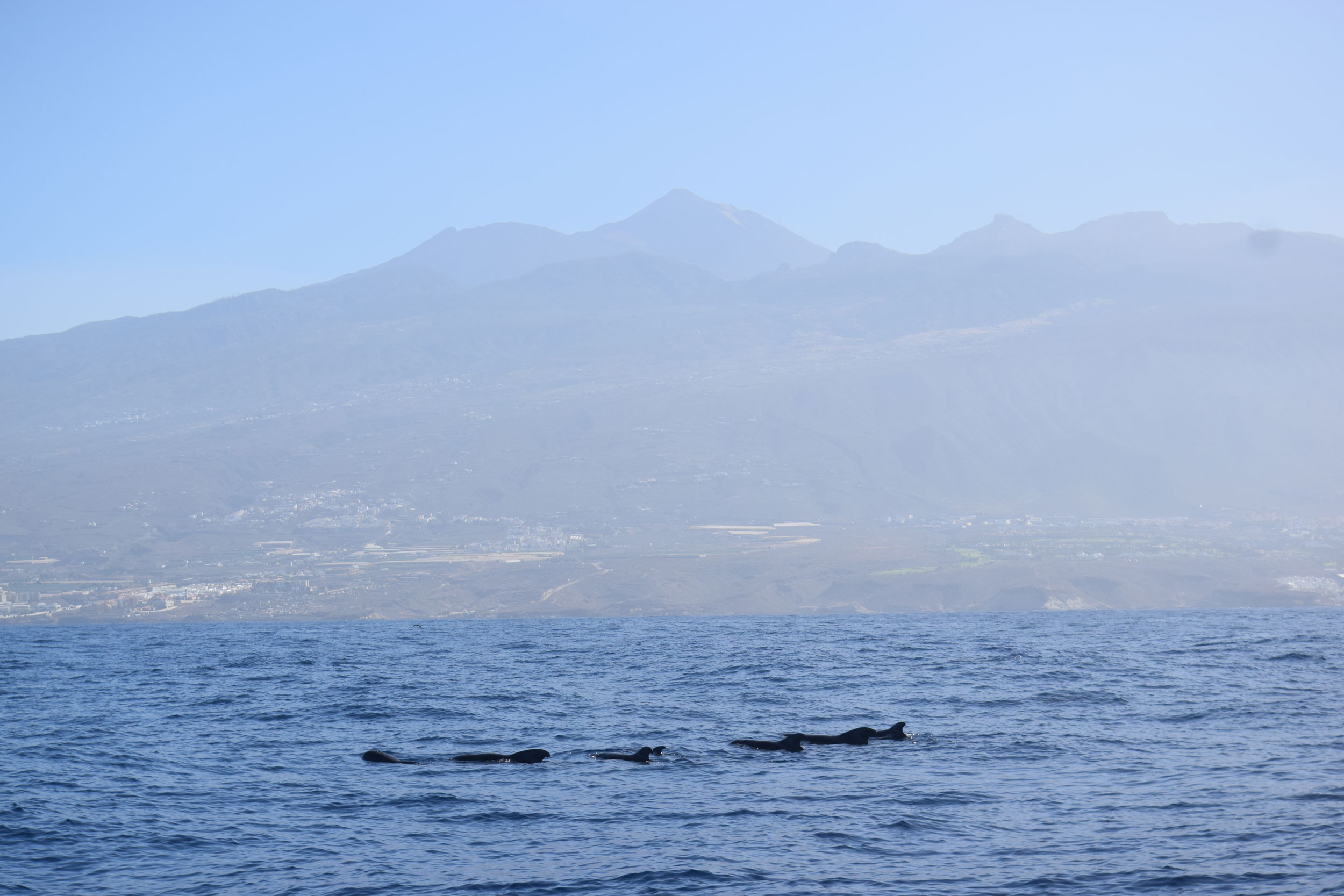
When we talk about whale watching in Tenerife, Costa Adeje plays a leading role.
Specialized boats depart daily from the ports of Puerto Colón and other nearby marinas, sailing towards the Teno-Rasca Marine Protected Area, one of the areas with the greatest biodiversity in the Canary Islands archipelago.
This marine area is recognized for its immense ecological value and constitutes one of the most important habitats in the Atlantic for numerous cetacean species.
Sea conditions are generally particularly favorable for much of the year, allowing for comfortable and safe excursions for families, couples, groups of friends, and nature photography enthusiasts.
Furthermore, the proximity of the coast to the areas where cetaceans are commonly found makes it possible to reach the observation area quickly, allowing you to spend more time enjoying the animals and less time sailing.
Much more than a boat trip
A whale and dolphin watching excursion in Tenerife is not simply about going out to sea to look for whales and dolphins.
The best experiences combine responsible observation, environmental interpretation, and scientific outreach so that each visitor understands the importance of conserving this unique ecosystem.
During the boat trip, you will learn how these species live, how they communicate using complex sound systems and echolocation, what their feeding habits are, and what threats they currently face in the oceans.
This educational approach transforms the excursion into a much more enriching experience, especially for families with children and travelers interested in nature.
What makes Whale Watch Tenerife different? Choosing the right company can make all the difference between a simple excursion and an unforgettable experience.
Whale Watch Tenerife stands out for offering a marine tourism concept based on respect for animals, scientific outreach, and sustainability.
One of the aspects most valued by visitors is that the excursions are led by marine biologists and specialized guides, who explain the behavior of each species and answer passengers’ questions throughout the trip.
Their knowledge of the ecosystem allows them to interpret each encounter with cetaceans from a scientific perspective, making every outing unique.
Small groups for an exclusive experience: group tours and private tours
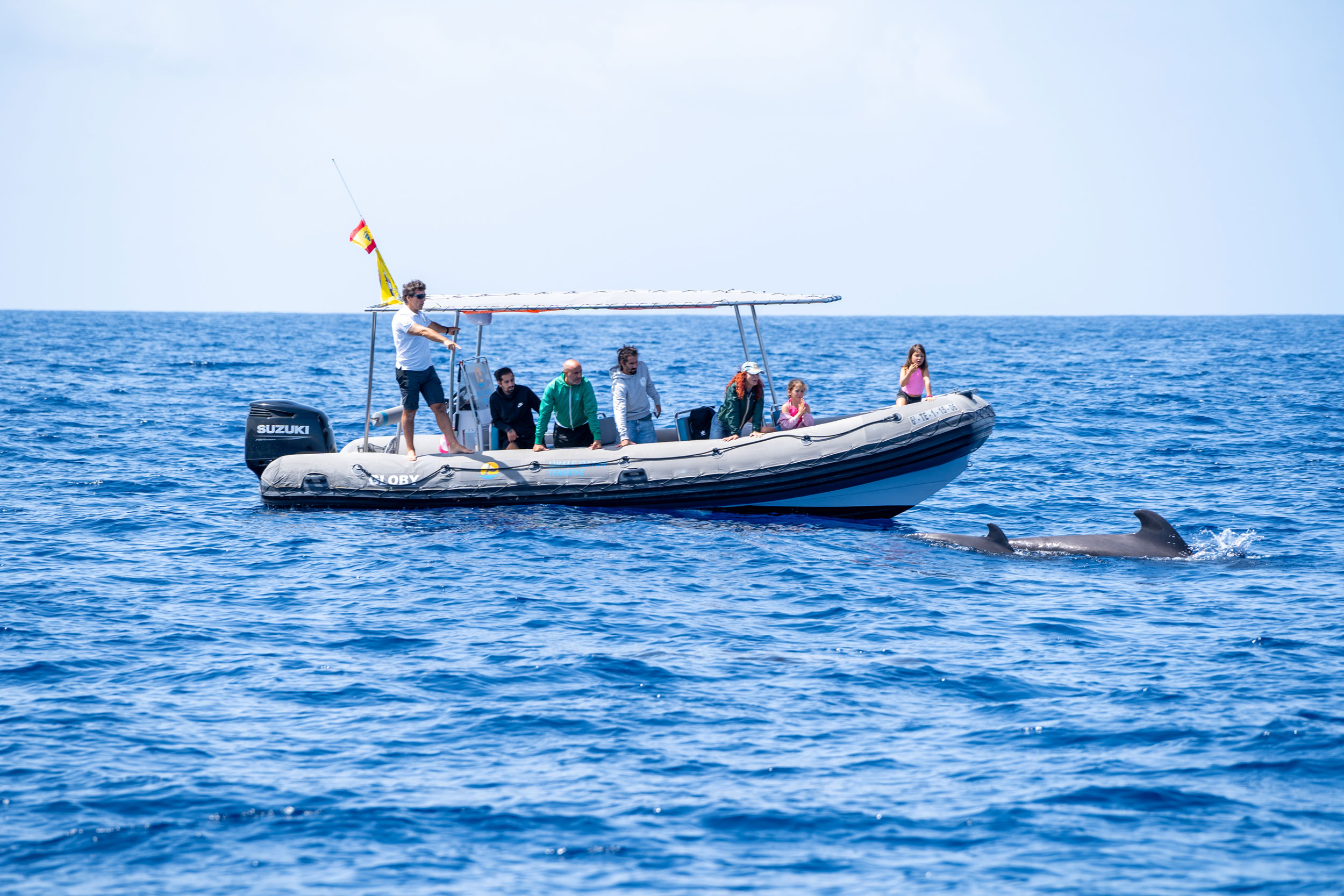
Unlike large tourist boats, Whale Watch Tenerife focuses on excursions with small groups, allowing you to enjoy a much more relaxed and personalized atmosphere. Our Globy boat is designed to offer a comfortable excursion for all our passengers.
A limited number of passengers allows for better visibility, greater comfort on board, and a more respectful experience with the animals.
In addition, the guides can dedicate more time to explaining the characteristics of each species and attend to each participant individually.
Listen to the Whales and Whales Underwater
One of the most amazing moments of the excursion comes when the crew uses a hydrophone, an underwater microphone capable of capturing the sounds emitted by whales and dolphins.
Thanks to this technology, you can hear whistles, clicks, and other sounds that are part of their communication system and echolocation.
This is an experience rarely found on most conventional excursions and allows for a much better understanding of the behavior of these fascinating marine mammals.
It is an experience rarely found on most conventional excursions and allows for a much better understanding of the behavior of these fascinating marine mammals.
A company committed to conservation
Whale watching in Tenerife only makes sense if it is done with respect for the animals and their environment.
Therefore, Whale Watch Tenerife operates following strict responsible navigation protocols and has the official permits required by the Government of the Canary Islands to operate in areas where cetaceans are commonly found.
Their commitment to conservation goes far beyond simply complying with regulations.
The company actively participates in scientific research projects, collaborates with universities and organizations dedicated to the study of cetaceans, and shares photographs and identification data that help to better understand the resident populations.
This collaborative work contributes to improving the protection of species such as the short-finned pilot whale and the bottlenose dolphin, two of the main inhabitants of the waters south of Tenerife.
What is a whale and dolphin watching excursion like in Tenerife?
The experience begins at the port, where the crew welcomes the passengers and explains the basic rules to ensure safe and respectful navigation with marine wildlife.
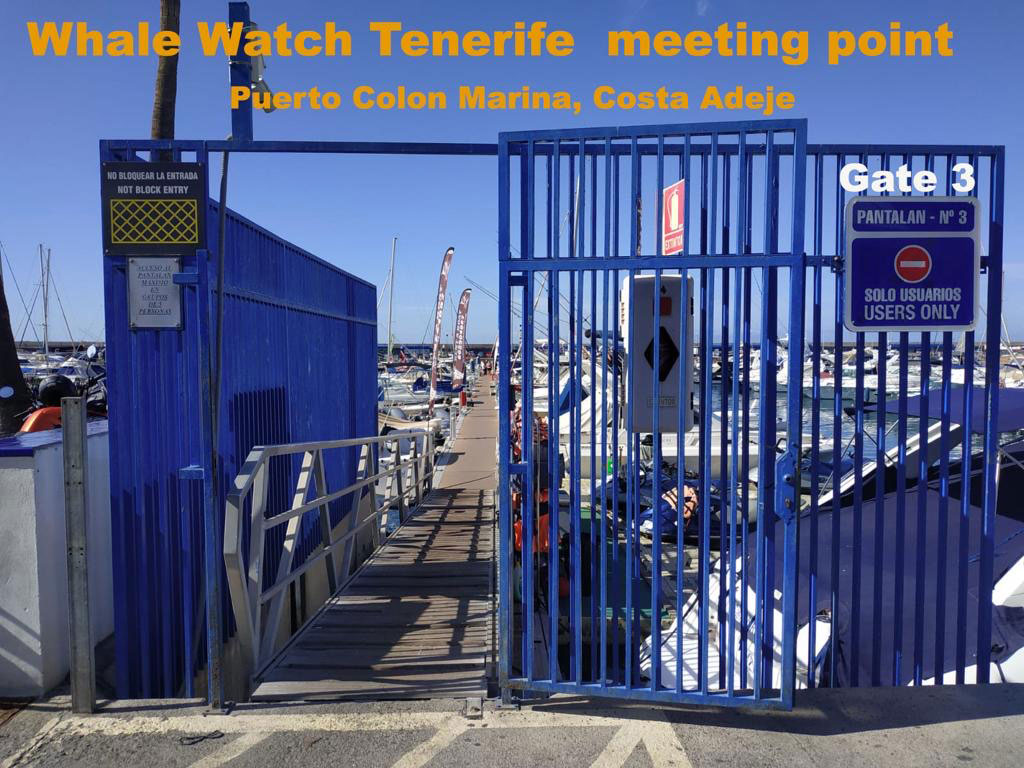
After leaving the coast, the boat heads towards the areas where whales are commonly found.
During the tour, the guides interpret the seascape and provide information about Tenerife’s volcanic geology, the ecosystem of the Teno-Rasca protected area, and the species that might be encountered.
When the first dolphins or pilot whales appear, the boat stops completely or slows down to observe them without interfering with their natural behavior.
It’s common to see family groups swimming alongside the boat, mothers with their calves, or individuals that surface slowly to breathe before diving again.
Each encounter is different, and that’s precisely where the magic of whale watching in Tenerife lies: observing animals completely free in one of Europe’s most privileged marine habitats.
In the second part of this guide you will learn in detail about all the species that can be observed in Tenerife, the best time of year for each of them and some tips to enjoy the experience like a true cetacean expert.
One of the great attractions of whale watching in Tenerife is the extraordinary diversity of species that inhabit or visit the waters of the Canary Islands. Thanks to the depth of the ocean and the abundance of food, Tenerife has become one of the few places in Europe where it is possible to observe cetaceans all year round.
More than 20 different species of whales and dolphins have been identified in the waters surrounding the island. Some are permanent residents, while others appear seasonally during their migratory routes or in search of food.
The deep waters located off Costa Adeje, next to the Teno-Rasca protected marine area, constitute an authentic natural corridor for whales and dolphins. Each excursion is unique, but knowing the species that inhabit this environment allows you to enjoy the experience even more.
Tropical pilot whale: the main protagonist of whale watching in Tenerife
The tropical pilot whale (Globicephala macrorhynchus) is the most emblematic species in the south of Tenerife and one of the main reasons why thousands of people go on whale watching excursions every year.
The waters between Tenerife and La Gomera are home to one of the most important resident populations of pilot whales in the world. These animals live in stable family groups and remain in the area throughout the year thanks to the abundance of food.
Pilot whales are very social and intelligent cetaceans. They move in groups of between 10 and 30 individuals, although sometimes much larger groupings can be observed.
Their diet is based mainly on squid and fish that live in the deep volcanic waters of the island. To capture them, they make dives that can exceed 1,000 meters deep.
One of the most fascinating features of this species is its communication system. Pilot whales emit a wide variety of sounds and clicks that they use to orient themselves, locate food and stay in contact with the group.
Thanks to the use of hydrophones during some excursions, visitors can listen to these sounds and discover a world hidden beneath the surface of the ocean.
During an outing it is common to observe how they slowly emerge to breathe, interact with each other or move in perfect synchrony. Sometimes babies can also be seen accompanying their mothers, offering unforgettable scenes.
Pilot whales can be observed on approximately 99% of the excursions, which makes whale watching in Tenerife an experience with a very high probability of success.
Bottlenose dolphin: intelligence and curiosity
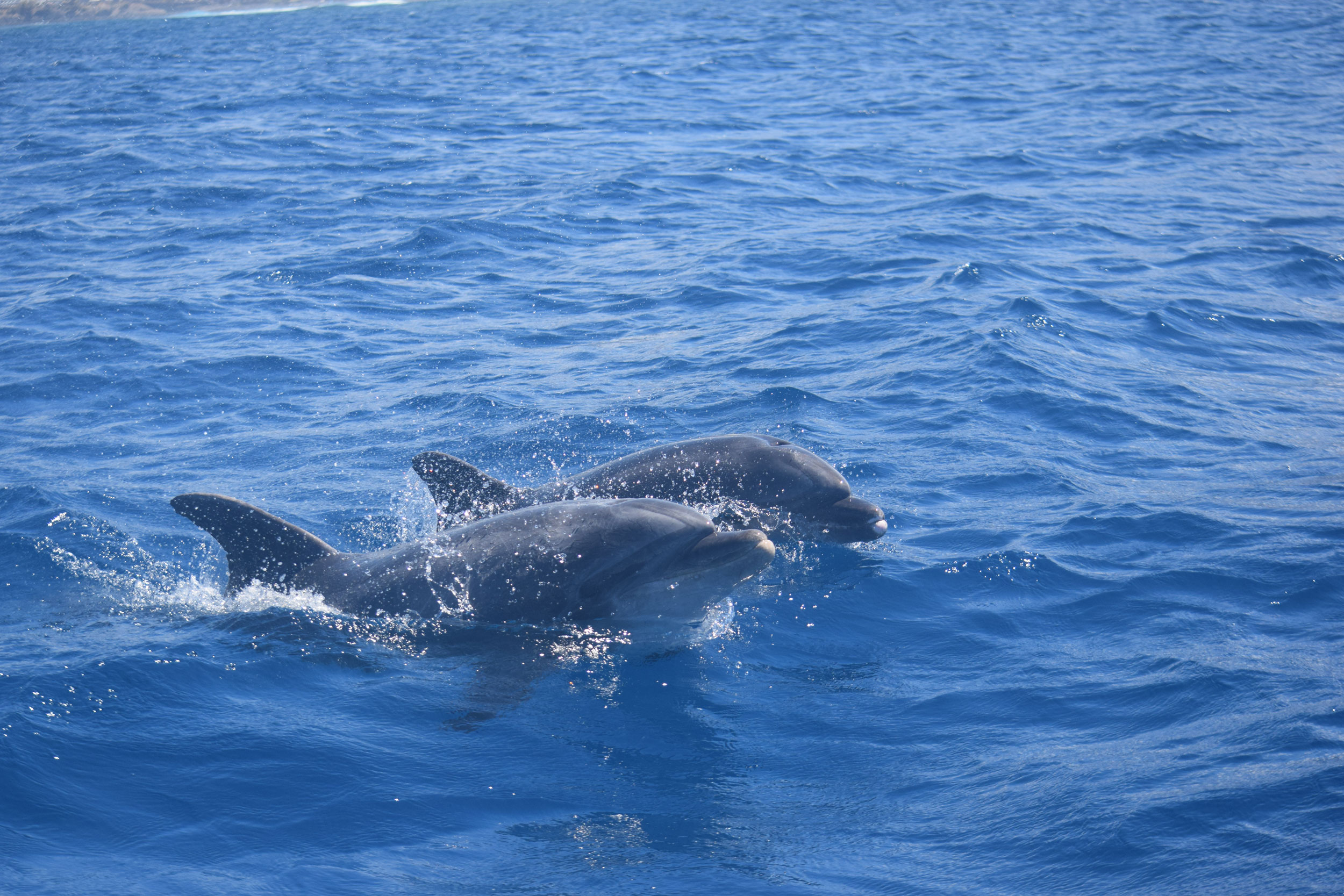
The bottlenose dolphin (Tursiops truncatus) is another of the resident species that can be observed throughout the year.
It is the best-known dolphin in the world and one of the most charismatic animals in the ocean. His curious and sociable nature means that he frequently approaches the boats, offering some of the most exciting moments of the excursion.
Bottlenose dolphins live in family groups and use complex communication systems based on whistles, clicks and sounds they produce through echolocation.
On some excursions it is possible to hear these sounds thanks to the use of an underwater hydrophone, an experience that allows you to discover the fascinating acoustic world of cetaceans.
STheir presence is common throughout the year, and they can be seen in small groups as well as larger gatherings, swimming alongside the boat, jumping, or interacting with each other.
Atlantic Spotted Dolphin: Speed and Spectacle
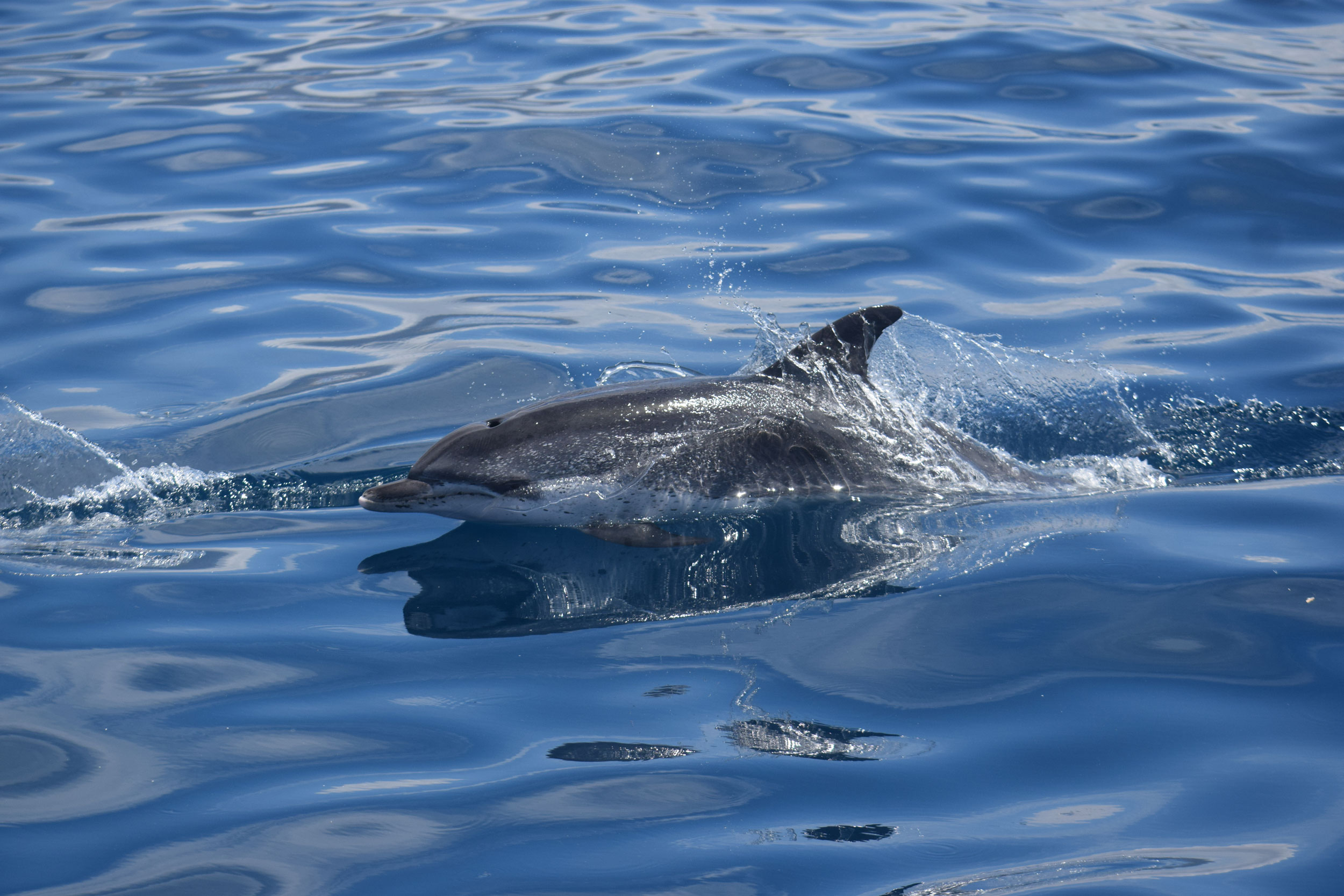
The Atlantic Spotted Dolphin (Stenella frontalis) is one of the most spectacular and elegant species that can be observed in Tenerife.
Its streamlined, silvery-gray body is covered in small dark spots that increase with age, giving it a very distinctive and easily recognizable appearance.
They are extremely fast and active animals, capable of spectacular leaps and high-speed acrobatics.
They often travel in large groups, known as megagroups, which can exceed 50 individuals and offer a truly spectacular natural display for visitors.
Although they can be seen year-round, encounters depend on the availability of food and sea conditions.
Bryde’s Whale: The Resident Baleen Whale
The Bryde’s whale (Balaenoptera edeni) is one of the baleen whale species that can be found in the waters of Tenerife.
Unlike other large whales that undertake long migrations, the Bryde’s whale maintains a relatively stable presence in the Canary Islands archipelago.
It can exceed 15 meters in length and usually feeds on small fish and schools of sardines, often accompanied by seabirds and dolphins.
Watching a fin whale blow or seeing it slowly surface is one of the most impressive moments of the excursion, both for its size and the elegance with which it moves.
Sperm Whale: The Giant of the Deep
The sperm whale (Physeter macrocephalus) is one of the most fascinating cetaceans on the planet.
These enormous toothed whales dive to depths of up to two kilometers in search of giant squid.
The proximity of deep waters to the coast makes Tenerife one of the few places in Europe where it is possible to observe sperm whales without having to undertake long sea voyages.
Although sightings are less frequent than those of pilot whales and dolphins, each encounter is unforgettable. Family groups consisting of females and offspring are generally observed, while adult males tend to move more independently.
Their enormous heads and distinctive angled blows make them easily recognizable.
Other cetacean species that can be seen in Tenerife
In addition to the resident species, the waters of Tenerife are occasionally visited by other cetaceans:
- Common dolphin.
- Striped dolphin.
- Orca.
- False killer whale.
- Risso’s whale.
- Finnish fin whale.
- Humpback whale.
- Blue whale (in very exceptional cases).
- Beaked whale.
These species usually appear during migrations or at specific times of the year, making each excursion different and full of surprises.
What is the best time for whale and dolphin watching in Tenerife?
One of the great advantages of Tenerife is that whale and dolphin watching can be done 365 days a year.
The subtropical climate maintains pleasant temperatures and favorable sailing conditions in any season. Thanks to the resident populations, there are always excellent opportunities to observe dolphins and whales.
Spring
Spring offers very calm sea conditions and excellent visibility. It is an ideal time to observe resident species and enjoy excursions with mild temperatures, as well as increased activity for many species.
Summer
Summer is one of the busiest seasons for visitors. The ocean usually has calm waters, ideal for families and photography, and the presence of pilot whales and dolphins remains very high.
Autumn
During autumn, the ocean maintains pleasant temperatures and good sailing conditions, offering the possibility of observing both resident and some visiting species.
Winter
Between November and February, the presence of migratory cetaceans increases, offering the opportunity to observe a greater diversity of species. For this reason, many experts consider this one of the most interesting times of the year.
However, any month of the year offers excellent opportunities to enjoy the experience in southern Tenerife.
Tips for photographing cetaceans
If you want to take home spectacular images of your experience, these tips can help you:
- Use fast shutter speeds.
- Bring a camera with zoom or a phone with good camera capabilities.
- Keep your camera ready at all times.
- Observe the direction of the animals before photographing them.
- Avoid using flash.
- Protect your equipment from water and sun.
- Always follow the crew’s instructions.
- Enjoy the moment first before focusing on the photos.
Our excursions include professional photographs taken during the experience, allowing you to keep high-quality memories without worrying about capturing every moment.
A different experience on every trip
The sea is never the same, and cetaceans are completely free animals. That’s why every whale watching excursion in Tenerife is unique.
One day you might see a group of pilot whales resting with their calves; another, a pod of dolphins accompanying the boat; and on special occasions, the appearance of large whales or rare species will make the trip a lifelong memory.
Whale and dolphin watching is more than just seeing whales and dolphins: it’s an opportunity to understand the importance of the ocean, learn about the scientific work that helps protect these species, and connect with nature in an authentic and respectful way.
In the third part of this guide, you’ll discover how to choose a responsible excursion, what the Blue Boat certification means, how we collaborate on scientific projects, and answers to frequently asked questions before booking.
The success of whale and dolphin watching in Tenerife is measured not only by the number of whales and dolphins that can be observed during an excursion, but also by the commitment of the companies operating at sea to protecting this valuable ecosystem.
Each outing represents an opportunity to enjoy nature, but also to contribute to the conservation of the species that inhabit the waters of the Canary Islands archipelago. Choosing a responsible operator guarantees a more authentic experience and helps preserve one of the most important marine environments in Europe.
Why is it important to choose a responsible whale and dolphin watching company?
Cetaceans are wild and protected animals. Their well-being depends on vessels adhering to very strict navigation and observation regulations.
Authorized companies maintain a safe distance, limit the time spent with the animals, and adjust the vessel’s speed to avoid disturbing their natural behavior.
In addition to complying with the regulations of the Canary Islands Government, responsible operators develop environmental education programs so that each visitor understands the importance of conserving the marine environment.
When you book a whale watching excursion in Tenerife with a committed company, you not only enjoy a higher quality experience, but you also contribute to the protection of resident species.
Whale Watch Tenerife: Commitment to Conservation
At Whale Watch Tenerife, respect for cetaceans is part of the philosophy of every excursion.
The team works with marine biologists and specialized guides, who interpret the animals’ behavior and explain to visitors how to interact with them responsibly.
This scientific approach transforms each trip to sea into an educational experience, where observation is combined with learning and environmental awareness.
Furthermore, we actively participate in research projects by collecting photographs and sighting records that help identify individuals, study their movements, and better understand the evolution of resident populations.
This collaboration with researchers and scientific organizations provides valuable information for the conservation of cetaceans in the Canary Islands.
Blue Boat Certification: A Guarantee of Quality
One of the aspects you should consider before booking an excursion is that the company has the official permits for whale watching in Tenerife.
The Blue Boat certification verifies that the vessel meets the requirements established by the authorities to carry out the activity while respecting marine wildlife.
This distinction guarantees that the company follows good environmental practices, collaborates in the conservation of cetaceans, and promotes a sustainable tourism model.
Choosing an accredited company is the best way to enjoy a responsible and safe experience.
An Experience for the Whole Family
Whale and dolphin watching in Tenerife is an activity suitable for all ages. The excursions are ideal for families with children, couples, groups of friends, and nature lovers.
Young children discover how whales and dolphins live while learning about the importance of protecting the oceans, making the excursion an educational and fun experience.
For photography enthusiasts, each outing offers the opportunity to capture unique images of cetaceans in their natural habitat with Tenerife’s stunning volcanic landscape as a backdrop.
See all our whale watching tours here.
Tips Before Boarding
To fully enjoy the experience, please keep the following recommendations in mind:
- Book in advance, especially during holidays and peak season.
- Wear comfortable clothing and a light jacket, as it can feel cooler at sea.
- Use sunscreen, a hat, and sunglasses.
- Bring water and avoid heavy meals before boarding if you are prone to seasickness.
- Always follow the crew’s instructions to ensure the safety and well-being of the animals.
With proper preparation, all you have to worry about is enjoying the spectacle the ocean offers.
Frequently Asked Questions about Whale and Dolphin Watching in Tenerife
Can whales and dolphins be seen year-round?
Yes. Tenerife is one of the few destinations in the world with resident populations of short-finned pilot whales and bottlenose dolphins, so whale and dolphin watching is possible 365 days a year.
What are the chances of seeing whales and dolphins?
Excursions in southern Tenerife offer a very high chance of sightings. Short-finned pilot whales are present on the vast majority of trips, and bottlenose dolphins are also frequently observed.
How long does an excursion last?
Most excursions last approximately two to three hours, enough time to sail to the areas with the highest whale and dolphin activity and enjoy the experience at a relaxed pace.
Is this a suitable activity for children?
Yes. Whale watching in Tenerife is a family activity that allows children to experience marine biodiversity firsthand and learn about the importance of ocean conservation.
What happens if no whales are sighted?
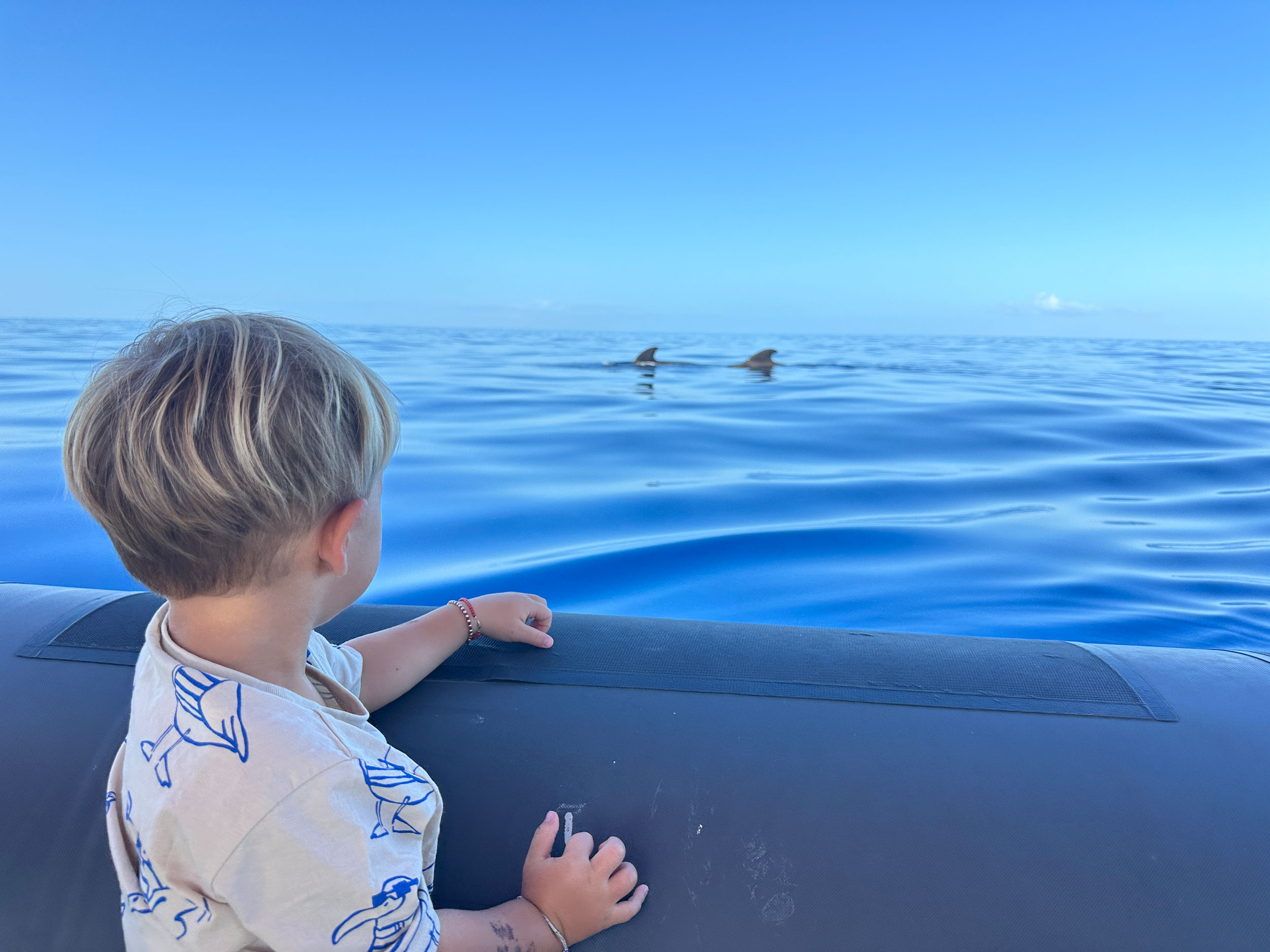
Although the probability of sightings is very high (99%), whales and dolphins live in the wild. That’s why we offer guaranteed sightings: if you don’t see whales or dolphins during the tour, we invite our guests to repeat the excursion free of charge, subject only to availability.
When is the best time to take the excursion?
Any time of year is excellent for whale watching in Tenerife. If you want to increase your chances of seeing migratory species, the winter months and early spring are usually particularly interesting.
Live an unforgettable experience in Tenerife
Watching a family of pilot whales moving peacefully through the ocean, seeing a group of dolphins playing alongside the boat, or listening to the sounds they make underwater are moments that will stay with you forever.
Whale watching in Tenerife is much more than a tourist excursion. It’s an opportunity to discover one of Europe’s most extraordinary marine ecosystems, learn from professionals passionate about marine biology, and contribute to the conservation of unique species.
If you’re planning your trip to the island, we recommend consulting the Whale Watching Guide for Tenerife, where you’ll find practical information to prepare your excursion and answer any questions you may have before setting sail.
And if you’ve already decided to experience this adventure, book your spot with Whale Watch Tenerife and enjoy a small-group excursion, guided by marine biologists and designed to offer an intimate, educational, and environmentally responsible experience.