If you’re planning your holiday in the Canary Islands, you’re probably wondering when the best time to see whales and dolphins in Tenerife is. The good news is that Tenerife is one of the few destinations in the world where whale and dolphin watching is possible all year round thanks to its exceptional natural conditions.

The waters surrounding the island are home to resident populations of short-finned pilot whales and bottlenose dolphins, while also welcoming numerous migratory species throughout the year. This means that every season offers the opportunity to enjoy an unforgettable experience observing cetaceans in their natural habitat.

However, each time of year has its own unique characteristics. Depending on the month you visit, you may encounter different species, varying sea conditions, and unique opportunities to enjoy an unforgettable excursion.

In this guide, you’ll discover the best time to watch whales and dolphins, which species you can expect to see in each season, and why Tenerife has become one of Europe’s leading whale watching destinations.

Why is Tenerife a unique place to see whales and dolphins?

The success of whale watching in Tenerife is no coincidence. The island offers exceptional geographical and oceanographic conditions that support the year-round presence of a wide variety of cetacean species.

Tenerife’s volcanic origin has created a unique underwater landscape. Just off the coast of Costa Adeje, the seabed drops rapidly to depths of more than 2,000 metres. These deep waters are especially rich in nutrients and support large populations of fish and squid, the primary food source for many cetacean species.

In addition, the marine channel between Tenerife and La Gomera forms a true biological corridor where numerous species feed, rest, and travel throughout the year.

Thanks to these exceptional conditions, Tenerife offers one of the highest whale-watching success rates in Europe, making it a must-visit destination for nature lovers and marine wildlife enthusiasts.

Can you see whales and dolphins all year round?

Yes. This is one of the greatest advantages of whale watching in Tenerife.

While in many destinations whale watching depends entirely on seasonal migrations, Tenerife is home to resident populations that remain around the island throughout all twelve months of the year.

The main species are:

These species find abundant food in the waters off southern Tenerife, so they do not need to migrate. They are joined by other visiting species, including:
  • Atlantic spotted dolphin.
  • Bryde’s whale.
  • Sperm whale.
  • Striped dolphin.
  • Fin whale.
  • Beaked whales.
  • False killer whale.
For this reason, every excursion offers a genuine chance to observe cetaceans, although the variety of species changes depending on the time of year.

When is the best time to see whales and dolphins in Tenerife?

Tenerife enjoys a strategic location for whale watching, making it possible to observe cetaceans throughout the year.

Spring (March to May)

Spring is one of the favourite seasons for many sea lovers.

Temperatures are pleasant, the ocean is usually calm, and excursions benefit from excellent visibility.

It is an ideal time to observe:

In addition, as this season attracts fewer tourists than summer, excursions are usually more relaxed and less crowded.

Summer (June to September)

During the summer, the number of visitors taking part in whale watching excursions in Tenerife increases significantly.

Weather conditions are generally excellent, and the sea remains relatively calm on most days.

It is the perfect season for families with children and for those who want to combine the excursion with other water activities.

Resident pilot whales and bottlenose dolphins continue to be seen in very high numbers.

The role of Costa Adeje in whale watching

Costa Adeje is the main departure point for whale watching excursions in Tenerife.

Every day, specialised boats depart from Puerto Colón to the protected Teno-Rasca marine area, considered one of the Atlantic’s most important locations for observing cetaceans.

The short distance between the harbour and the areas where the animals are commonly found reduces travel time, allowing more time for responsible wildlife observation.

In addition, sea conditions in this area are generally especially favourable for much of the year.

What makes a Whale Watch Tenerife excursion different?

Not all whale watching excursions are the same.

Choosing a specialised company makes a significant difference, both in the quality of the experience and in the respect shown towards the animals.

Whale Watch Tenerife organises its excursions with a strong focus on environmental education, conservation, and scientific outreach.

Among the features that make the experience stand out are:

  • Excursions led by marine biologists and specialised professionals.
  • Small group sizes for a more personalised experience.
  • Use of a hydrophone to listen to whales and dolphins communicating underwater.
  • Responsible navigation that complies with official wildlife observation regulations.
  • Collaboration with scientific research and cetacean conservation projects.

This approach makes every excursion much more than just a boat trip—it becomes an educational experience that respects and protects the marine environment.

Is it worth taking an excursion if you have already seen dolphins somewhere else?

Definitely yes.

Whale watching in Tenerife offers a completely different experience for several reasons.

Firstly, it is the only area in the world with such an accessible resident population of short-finned pilot whales.

Secondly, the combination of volcanic landscapes, deep waters, and marine biodiversity makes every trip a unique experience.

In addition, science-focused excursions allow visitors to understand the behaviour of these animals and discover the importance of protecting this extraordinary ecosystem.

In the second part of this guide, we will take a detailed look at which species can be observed during each season of the year, when the chances of seeing large whales increase, and how to choose the best time to book your excursion.

Which species can you see depending on the time of year?

One of the aspects that makes whale watching in Tenerife so special is that every excursion is different. While the presence of some species is almost guaranteed throughout the year, others visit the waters of the archipelago seasonally, making every trip out to sea a unique experience.

The waters surrounding Tenerife are part of one of the most biodiverse marine ecosystems in Europe. Thanks to the influence of Atlantic currents and the spectacular underwater landscape created by the island’s volcanic activity, more than 30 species of cetaceans have been identified in the Canary Islands.

This biological richness makes Tenerife one of the world’s best destinations for nature lovers, photography enthusiasts, and responsible marine tourism.

Short-finned pilot whale: Tenerife’s most iconic resident

When talking about seeing whales in Tenerife, the undisputed star is the short-finned pilot whale (Globicephala macrorhynchus).

Although many people popularly consider it a whale, it actually belongs to the oceanic dolphin family. It is a highly social species that lives in stable family groups and maintains strong bonds between its members.
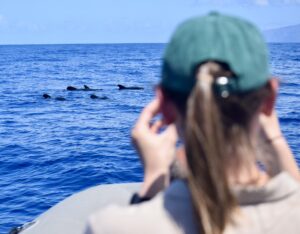
The resident population in southern Tenerife is considered one of the most important in the world, which is why thousands of visitors choose the island every year to observe them in the wild.

Pilot whales can measure between four and six metres in length and weigh more than two tonnes. They mainly feed on squid, which they catch by making deep dives during the night.

During the day, it is common to find them resting, moving slowly, or interacting with other members of their group, making them much easier to observe from authorised vessels.

Bottlenose dolphin: the regular companion of excursions

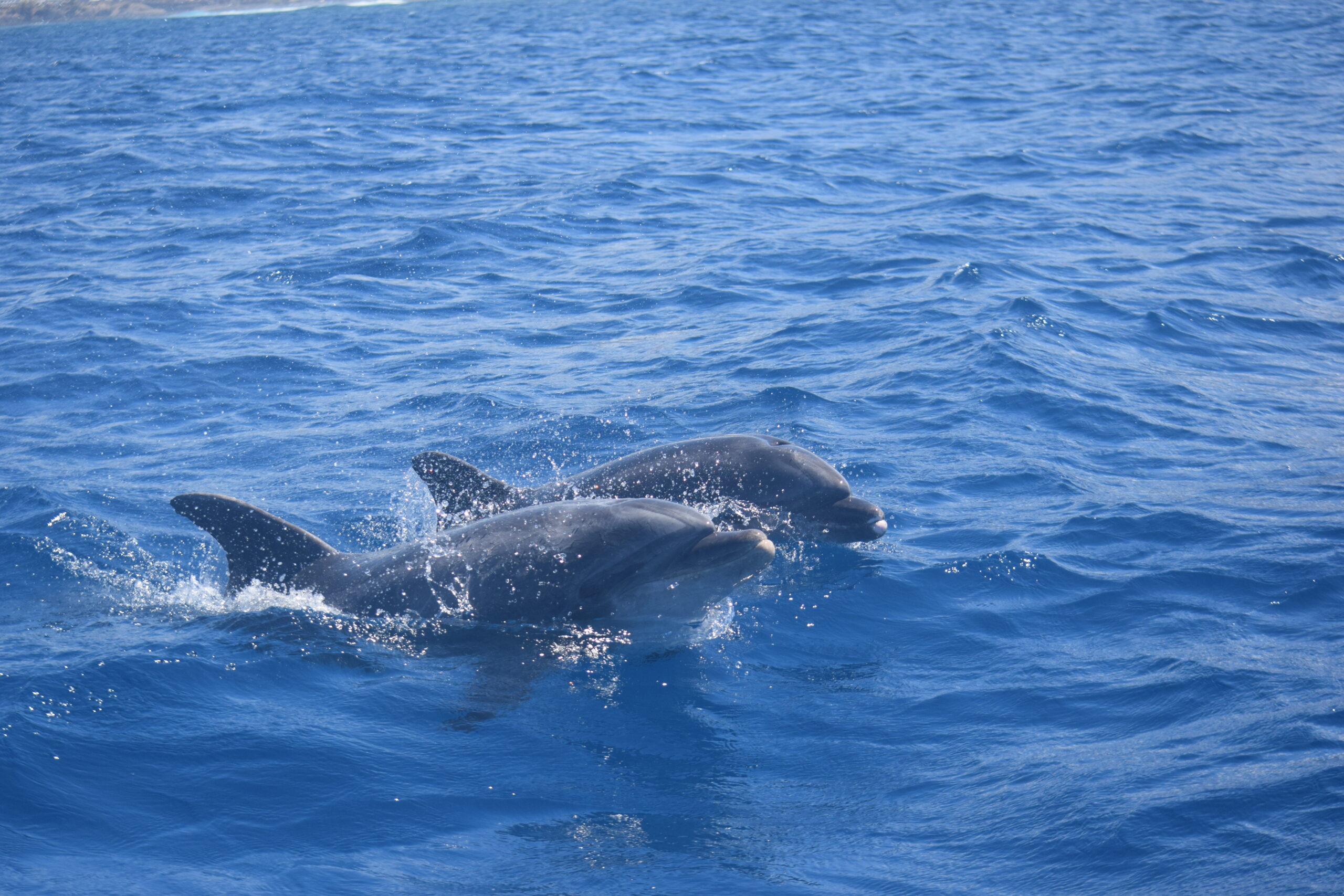
The bottlenose dolphin is another resident species that makes whale watching in Tenerife such a special experience.

Its curious and playful nature means that, on many occasions, it voluntarily approaches boats to ride the waves created by the bow of the vessel.
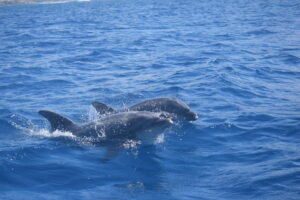
It is one of the most intelligent cetaceans on the planet and uses complex communication systems based on whistles and echolocation clicks.

At Whale Watch Tenerife, the use of a hydrophone allows visitors to listen to these sounds underwater, providing an immersive experience that surprises both adults and children.

Atlantic spotted dolphin

If you take your excursion during the warmer months, it is quite common to encounter groups of Atlantic spotted dolphins.

This species stands out for its extraordinary speed and the acrobatic displays it performs while swimming.
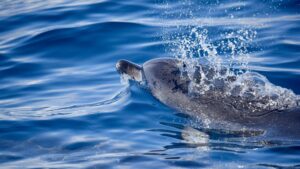
Adult individuals have numerous dark spots spread across their bodies, a characteristic that gives them their name and makes them easier to identify.

Sometimes they form large groups of dozens of individuals, offering one of the most exciting spectacles that can be experienced during a whale watching excursion in Tenerife.

Sperm whales: giants of the deep

Sperm whales are probably the most impressive cetaceans that can be observed in the waters around Tenerife.

They are the largest toothed predators on the planet and among the mammals capable of making some of the deepest dives in the world.

Thanks to the proximity of deep waters off Costa Adeje, sperm whales find an ideal environment for hunting giant squid.

Although sightings are less frequent than those of pilot whales or dolphins, every encounter is an unforgettable experience.

Watching the characteristic angled blow of a sperm whale slowly emerging from the ocean is one of the most anticipated moments for Tenerife whale watching enthusiasts.

Bryde’s whale

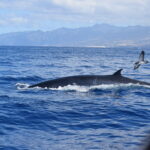
The Bryde’s whale is one of the few species of baleen whales that can be observed with some regularity around Tenerife.
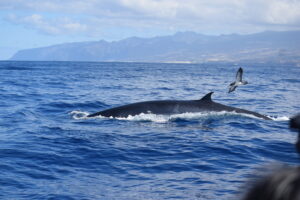
It can exceed 15 metres in length and usually feeds on small schools of fish near the surface.

When it surfaces to breathe, it creates a spectacular sight that is difficult to forget.

Although its presence depends on ocean conditions, it is one of the species that makes the Canary Islands one of the most complete destinations for whale and dolphin watching.

Other visiting species

Depending on the time of year and oceanographic conditions, other species may also appear, such as:

  • Striped dolphin.
  • Common dolphin.
  • Beaked whales.
  • False killer whale.
  • Fin whale.
  • Orcas (very rare sightings).
  • Blue whale (extremely rare).

This diversity is precisely what makes every excursion different from the next.

What is the best month to see whales and dolphins in Tenerife?

Although the short answer is any month of the year, each season offers a slightly different experience.

January and February

These months are especially interesting for those interested in large whales.

During winter, the chances of spotting migratory species increase, while short-finned pilot whales and bottlenose dolphins continue to be present.

In addition, temperatures in Tenerife remain very pleasant, making the island a perfect destination to escape the cold European winter.

March, April and May

Spring combines excellent weather conditions with fewer tourists.

The sea is usually calm, and excursions offer great conditions for wildlife observation and photography.

It is a highly recommended time for families and travellers looking for a more relaxed experience.

June, July and August

Summer is the busiest season.

Temperatures are ideal, and the ocean usually remains stable throughout most of the day.

If you are travelling during these months, it is advisable to book your excursion well in advance to secure availability.

September and October

Many experts consider these months to offer some of the best conditions of the year.

The sea retains the warmth accumulated during summer, the weather remains excellent, and visitor numbers decrease compared to August.

November and December

The end of autumn marks the beginning of the most interesting period for some migratory species.

In addition, Tenerife continues to enjoy mild temperatures, allowing excursions to be carried out in complete comfort.

How to choose the best excursion

Not all companies offer the same experience.

Before booking, it is worth checking some important aspects:

  • That the company has official authorisation to carry out whale and dolphin watching activities.
  • That it limits the number of passengers per boat.
  • That it promotes responsible wildlife observation.
  • That it has specialised guides.
  • That it participates in conservation and research initiatives.

Choosing a committed operator not only improves the quality of the excursion but also helps protect the species that make Tenerife a unique destination.

In the third and final part, you will discover how responsible tourism contributes to cetacean conservation, we will answer the most frequently asked questions before booking, and you will find practical recommendations to make the most of your whale watching experience in Tenerife.

Responsible tourism, practical advice and frequently asked questions about whale watching in Tenerife

Whale watching in Tenerife is much more than a tourist activity. Every excursion is an opportunity to discover the extraordinary biodiversity of the Atlantic Ocean while also contributing to the conservation of some of the most fascinating marine species on the planet.

The waters of southern Tenerife are home to resident cetacean populations that depend on a calm and protected environment to feed, reproduce, and care for their young. For this reason, the way excursions are carried out is essential to ensure that this experience remains sustainable in the future.

Choosing a company committed to the marine environment not only improves the quality of the excursion but also helps protect a unique ecosystem that makes Tenerife one of the world’s best destinations for whale watching.

Responsible tourism: the key to protecting whales and dolphins

Cetaceans are wild animals that live freely in their natural environment. Observing them requires the utmost respect, avoiding any behaviour that could disturb their natural habits.

Authorised companies follow specific protocols to minimise the impact of boats. These include:

  • Maintaining an appropriate observation distance.
  • Reducing speed when approaching the animals.
  • Avoiding chasing groups of cetaceans.
  • Limiting observation time.
  • Adapting navigation when calves are present.

These practices allow visitors to enjoy authentic encounters without interfering with the natural behaviour of the animals.

The importance of choosing an authorised company

When booking an excursion to see whales and dolphins, it is advisable to check that the company has the official authorisations required to carry out the activity. Authorised companies comply with the regulations established by the Government of the Canary Islands and operate according to conservation and animal welfare principles. In addition to providing a higher-quality experience, they actively contribute to the protection of resident cetacean populations through collaboration with scientific projects and environmental education programmes.

The added value of an excursion guided by marine biologists

One of the aspects that makes Whale Watch Tenerife different is that its excursions are accompanied by marine biologists and specialised guides. During the trip, you will not only learn how to identify the species you encounter, but also discover how they live, how they communicate, and why the waters around Tenerife are so important for their survival. This educational approach transforms a simple boat trip into a learning experience for the whole family. The guides explain topics such as:
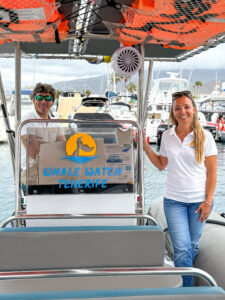
  • The differences between whales and dolphins.
  • How echolocation works.
  • The social organisation of short-finned pilot whales.
  • The feeding habits of each species.
  • The threats currently affecting the oceans.
Thanks to this knowledge, visitors gain a deeper understanding of the enormous value of the Canary Islands’ marine ecosystem.

Listening to cetaceans underwater

One of the most surprising experiences offered by some excursions is the opportunity to listen to cetaceans using a hydrophone. This device captures the clicks, whistles, and sounds that whales and dolphins use to communicate and navigate.
Listening to an underwater conversation between pilot whales or the sounds produced by a group of dolphins turns the excursion into an unforgettable experience.

What to bring to enjoy the excursion?

Preparing properly for your trip will help you make the most of the experience. We recommend bringing:
  • Sunscreen.
  • Sunglasses.
  • A cap or hat.
  • Comfortable clothing.
  • A light jacket for the boat trip.
  • Water.
  • A camera or phone with a good camera.
  • Binoculars, if you have them.
If you are prone to seasickness, ask your pharmacist about the best preventive option before boarding.

Tips for taking the best photographs

If you want to capture spectacular images during whale watching in Tenerife, keep these tips in mind:
  • Always keep your camera ready.
  • Use fast shutter speeds.
  • Avoid excessive zoom if you are using a mobile phone.
  • Observe the group’s behaviour to anticipate jumps or surfacing moments.
  • Remember to enjoy the moment without constantly looking through the viewfinder.
The best photographs usually happen when the animals behave completely naturally.

Frequently asked questions

What is the best season to see whales and dolphins in Tenerife?

The great news is that whale watching in Tenerife can be enjoyed all year round. Short-finned pilot whales and bottlenose dolphins are resident species, so there is always a high chance of spotting them.

What is the best month to take an excursion?

There is no single perfect month. If you are looking for greater species diversity, winter and early spring are often especially interesting due to the arrival of migratory cetaceans. If you prefer calmer seas and warmer temperatures, summer and early autumn are excellent options.

Can you see whales on every excursion?

Cetaceans live in the wild, and no responsible operator can guarantee a 100% sighting. However, thanks to the resident populations in southern Tenerife, the chances are very high throughout the year.

Is the activity suitable for children?

Yes. It is a perfect experience for families, combining nature, environmental education, and adventure in a safe environment.

How long does an excursion last?

Most excursions last between two and three hours, although longer trips are also available for those who want to enjoy a more complete experience.

Is it necessary to book in advance?

Yes. Especially during high season, Easter, summer, and Christmas, demand increases considerably. Booking in advance will allow you to choose the time that best suits your trip.

Why does Tenerife remain one of the best destinations in the world for whale watching?

There are few places on the planet that combine so many advantages for observing whales and dolphins in the wild:
  • Cetaceans present all year round.
  • Resident populations of short-finned pilot whales and bottlenose dolphins.
  • More than 30 identified cetacean species in the archipelago.
  • Subtropical climate with pleasant temperatures 365 days a year.
  • Short boat trips from Costa Adeje to the observation areas.
  • Specialised companies committed to conservation.
  • Excursions guided by marine biologists.
All of this makes Tenerife an essential destination for anyone who loves the sea and nature.

Book your whale watching experience in Tenerife

If you are planning your trip to the Canary Islands, including an excursion to observe whales and dolphins in the wild is a decision you will not easily forget. Sailing through the Atlantic waters, watching a family of short-finned pilot whales, listening to dolphins through a hydrophone, and learning alongside marine biologists is an experience that goes far beyond a simple tourist activity. At Whale Watch Tenerife, you will find excursions designed to enjoy the ocean responsibly, in small groups and with a strong commitment to cetacean conservation. Book your place in advance and discover why thousands of travellers consider whale watching in Tenerife one of the must-do experiences during their visit to the island.